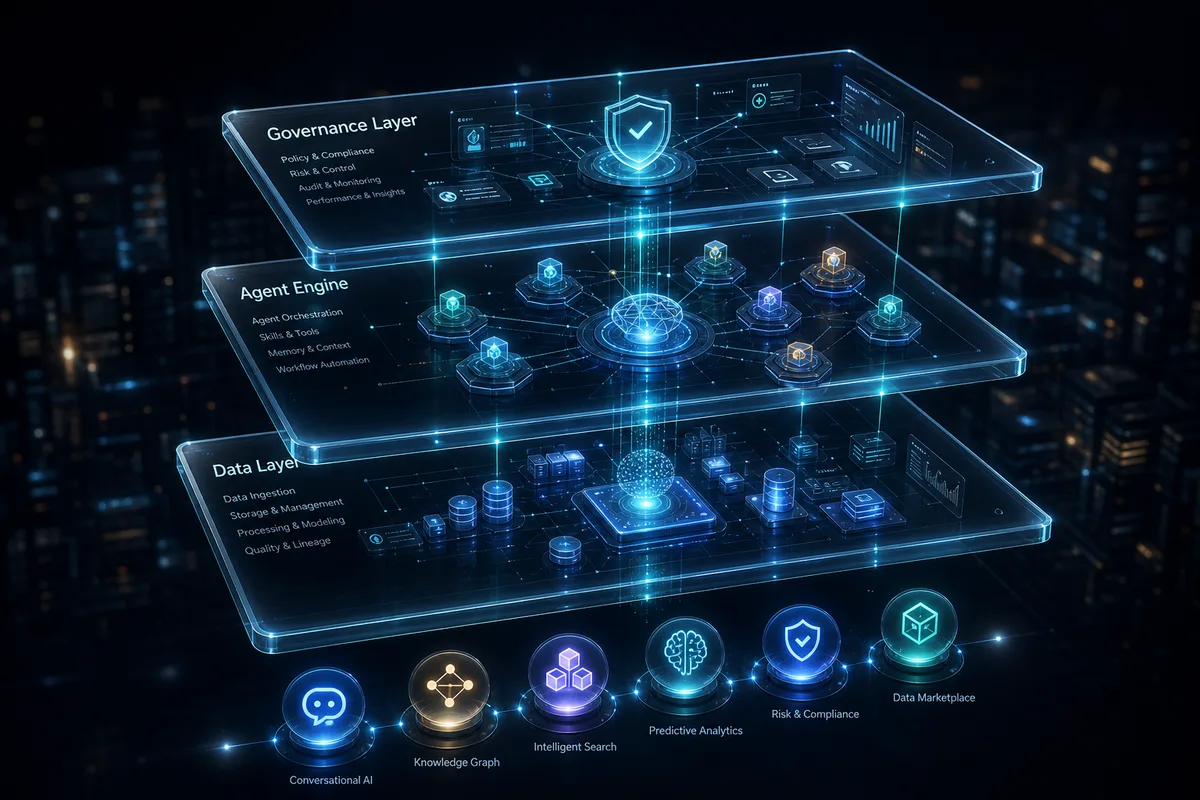
Over the past three years, enterprise AI shopping lists have grown longer: writing assistants, code copilots, support bots, knowledge search. Each promises efficiency gains, yet organization-level ROI curves are flattening. The issue is not tool quality — it is isolation. Knowledge cannot accumulate, processes cannot orchestrate, governance cannot unify.
Three Layers: Cognition · Execution · Twin
Agentic OS decomposes organizational intelligence into three governable layers: ontology defines what the organization knows, agents define how it acts, and digital twins define how it sees itself. Feedback loops connect all three — every execution updates cognition, every decision enriches the twin.
3×
Faster decision cycles after system deployment (industry baseline)
67%
Pilot projects fail to scale due to missing unified governance
∞
Compounding growth — systems strengthen through use
"Point AI tools are rented muscle — powerful but not inheritable. Agentic OS is the organization's nervous system."
How Superclaw Delivers This
- Ontology layer: encode business concepts, process rules, and permission boundaries as a queryable knowledge graph
- Agent layer: multi-agent collaboration embedded in real workflows, not standalone chat windows
- Twin layer: real-time operational mapping so what-if reasoning becomes everyday decision tooling
Leading enterprises in 2026 no longer ask what AI to buy next — they ask how their Agentic OS evolves. Superclaw provides governable, auditable infrastructure that strengthens through use. Not Tools. Systems.