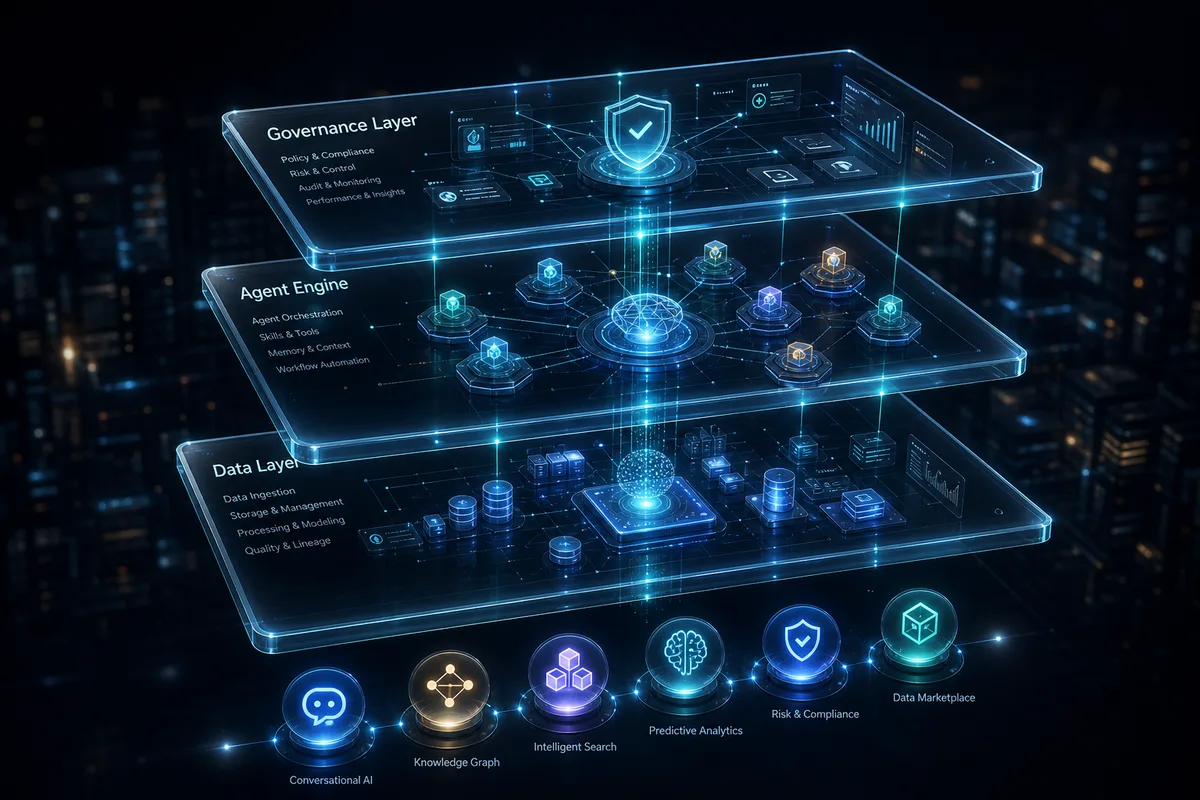
Most enterprise data strategies still focus on collecting more, storing longer, governing tighter. In the Agentic era, strategic value shifts fundamentally: petabytes in static warehouses contribute near-zero to organizational intelligence if they never enter agent execution loops.
From Warehouse to Engine: Three Data Leaps
- First leap (2010s): data lakes — storable, but hard to use
- Second leap (2020s): data platforms — queryable, but passive
- Third leap (2026+): data asset engine — appreciates through use, actively participates in decisions
The data asset engine's core mechanism is execution-as-accumulation: every agent handling a business request encodes context, decision paths, and outcome feedback back into the system. Three months later, the same agent network handling similar scenarios "remembers" how the organization solved it before — not because the model got smarter, but because data became an asset.
12×
Decision accuracy gap: closed-loop vs static data
85%
Enterprise data never enters any AI workflow (industry estimate)
Δ+
Marginal asset value added per agent execution
"Asking how many terabytes you have is an industrial-era question. Asking how many decision loops your data participated in is the intelligence-era question."
Superclaw Data Layer Design Principles
- Execution context auto-archival — every agent-handled scenario leaves searchable organizational memory
- Structured feedback signals — success/failure/correction triplets become training and optimization inputs
- Permission inheritance — data assets follow organizational permission models; agents access only governed assets